Use GEO, AI search optimisation and AI SEO together, with a clear explanation of what the service does. GEO names the work of improving visibility in AI-generated answers, while our own search data shows people finding Thrive through AI search optimisation and AI SEO queries. AEO describes direct-answer optimisation.
If you’ve been reading about search lately, you’ve probably seen all three terms. They describe overlapping work, which makes it easy to assume they mean exactly the same thing. The useful distinction is the kind of result you want your business to appear in.
AEO, GEO and AI SEO: what’s the difference?
A short answer in Google and a recommendation in an AI conversation are different kinds of visibility. Here’s how each term relates to those results.
What is AEO?
Answer engine optimisation, or AEO, focuses on making your content useful as a direct answer to someone’s question. It is commonly associated with featured snippets and spoken answers from voice assistants.
AEO’s roots predate today’s generative AI search tools. It grew out of making content useful for direct-answer features such as featured snippets and voice search. Google was already explaining how featured snippets supported voice answers in 2018. AEO now overlaps with AI search, but its scope still extends beyond generative AI.
Google’s 2018 explanation: https://blog.google/products-and-platforms/products/search/reintroduction-googles-featured-snippets/
For example, someone asks, “How often should I update my WordPress website?” A clear explanation on your site might be selected as a short answer. The aim is to answer the question accurately and make the source easy to understand.
AEO is also used more broadly to describe AI answer optimisation. That broader usage is why the boundary between AEO and GEO can be blurry.
What is GEO?
Generative engine optimisation, or GEO, focuses on your visibility in answers created by generative AI. This can include your website being cited as a source, your business being mentioned, or your services being recommended when relevant.
Think of a person asking an AI search tool to compare Shopify and WooCommerce for an Australian retailer. The response may combine information from several websites rather than extract one short answer. GEO describes the work of making your expertise and business information useful in that process.
The term appears in the research paper GEO: Generative Engine Optimization, accepted at KDD 2024. Microsoft also uses GEO when discussing its AI search reporting. It is an established term in research and industry discussion, although there is no universal naming standard.
Research: https://arxiv.org/abs/2311.09735
What is AI SEO?
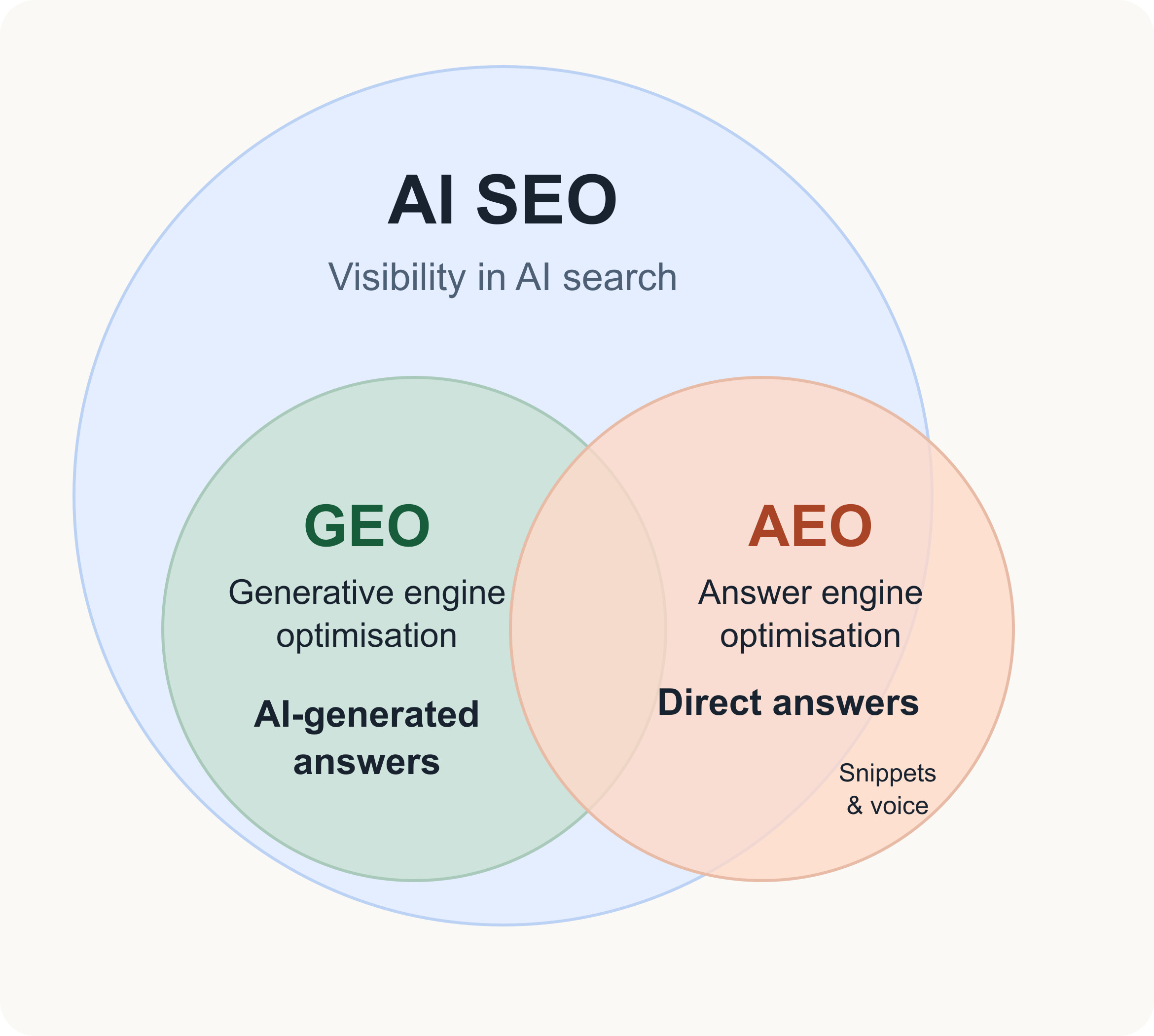
In this article, we use AI SEO as the umbrella term for improving visibility in AI-powered search. It includes GEO and overlaps with AEO, while recognising that AEO also covers direct answers outside generative AI. The name connects the subject to SEO, which many business owners already understand.
The catch is that it can also mean using AI software to do SEO tasks, such as researching topics or drafting page descriptions. That is different from helping customers discover your business through an AI answer. “AI search optimisation” makes the intended meaning clearer.
How AI SEO, GEO and AEO fit together
The graphic below shows how we use these terms: AI SEO is the umbrella, GEO focuses on AI-generated answers, and AEO overlaps with both while also covering direct answers outside AI search.
The table breaks that relationship down into each term’s focus, typical examples and useful ways to measure results.
Swipe sideways to view the full table.
| Term | Main focus | Typical example | Useful measures |
|---|---|---|---|
| AEO | Providing a clear direct answer | A featured snippet or spoken answer | Answer appearances and resulting visits, where measurable |
| GEO | Being represented in an AI-generated response | A source link or relevant business recommendation in an AI search answer | Citations, mentions, identifiable referrals and enquiries |
| AI SEO | A broad label for SEO related to AI search | Improving a website’s visibility across search and AI answers | Search performance, AI visibility and business outcomes |
Which term should your business use?
Use GEO, explained as generative engine optimisation, when discussing visibility in AI-generated answers. Give AI search optimisation and AI SEO equal prominence in client-facing wording. These terms already appear in relevant searches that have brought visitors to Thrive.
A service heading such as “AI Search Optimisation: GEO and AI SEO” combines everyday wording with the industry terminology. Use AEO when the discussion centres on answering questions directly. Choose wording based on relevant search data and the language your clients use, rather than the popularity of an acronym alone.
A straightforward service description would be: “We help improve your visibility in AI search, including how your website is cited and how your business is represented in relevant answers.” It explains the aim without promising that a platform will recommend you.
Industry terminology and client language are often different
The industry may call this GEO, AEO or AI SEO. A potential client might simply ask, “Can you get us showing in ChatGPT?” They are describing the outcome they want, without necessarily knowing the name of the service.
Other clients might ask how to get their business recommended by AI, appear in Google’s AI answers or bring more visitors from AI search. These are examples of everyday wording, rather than verified popular search phrases. They can also describe different goals: being mentioned, being cited as a source and attracting website visits are separate outcomes.
This makes demand hard to define and track. Searches for an industry term may come from agencies, researchers or people learning about the subject, as well as potential clients. Meanwhile, someone looking to hire an agency may use a question that contains none of the acronyms. Comparing GEO, AEO and AI SEO alone therefore gives us only part of the picture.
We would compare the full service names alongside plain-English questions and phrases that suggest someone wants help. Then we would check the wording used in actual enquiries. Search data can help identify patterns, but it cannot tell us every searcher’s intent or capture every conversation that leads to a client.
For website copy, our preference is to use both industry terminology and everyday language. Explain GEO alongside AI search optimisation and AI SEO, then answer the questions clients naturally ask. That makes the page useful to readers who know the terminology and those who are still working out what to call it.
Does Google Trends settle the naming question?
GEO is clearly ahead in the Google Trends snapshot supplied for this article. Across the Australian comparison shown, it has much higher relative search interest than AEO or AI SEO throughout the displayed period. AI SEO generally sits above AEO, although both remain well below GEO.
The chart below compares searches for “AEO”, “GEO” and “AI SEO” in Australia over the past 12 months. This is a rolling date range, so the chart will change over time.
Relative Google search interest in Australia over the past 12 months. Scores are normalised from 0 to 100 and do not represent monthly search volumes.
AEO and GEO also have meanings outside search optimisation. The chart shows that the search term GEO leads this comparison; it does not isolate interest in generative engine optimisation or prove industry adoption. We would not use this chart alone to choose the wording of a service page.
For a more focused comparison, use “answer engine optimisation”, “generative engine optimisation” and “AI SEO” with the same location and date range. Compare the “optimization” spellings separately, too. Low-volume terms may not produce usable data.
Open this comparison in Google Trends: https://trends.google.com/trends/explore?geo=AU&q=AEO,GEO,AI%20SEO&date=today%2012-m
How the data works: https://support.google.com/trends/answer/4365533
What our own search data shows
Thrive’s Google Search Console results show why a broad acronym comparison needs context. In the supplied reports, relevant searches for AI search optimisation and AI SEO brought visitors to our website, while AEO service queries recorded some impressions.
Swipe sideways to view the full table.
| Search query | Impressions | Clicks |
|---|---|---|
| ai search optimisation | 9924 | 8 |
| ai seo gold coast | 579 | 6 |
| local aeo services gold coast | 64 | 0 |
| aeo specialist gold coast | 11 | 0 |
| seo gold coast | 59603 | 24 |
The useful finding is that AI search optimisation and AI SEO already bring clicks to Thrive. That gives us a practical reason to keep both terms prominent alongside GEO. It does not establish which term has the most demand across the whole market: our visibility also depends on our existing pages and how they rank.
The reports also show how easily filtering can introduce unrelated results. A query filter containing “ai” includes words such as “email”, while “geo” includes “geolocation” and even “surgeon”. The displayed GEO results mostly relate to other subjects, so they do not establish demand for generative engine optimisation services.
We would compare relevant individual queries rather than the totals for these broad filters. Search Console shows searches where our website appeared, so an absent query does not mean nobody searches for it. Combined with the wording used in enquiries, these results are more useful for choosing client-facing language than an acronym chart alone.
What matters more than the acronym?
A useful website still needs clear information, evidence people can assess and pages that search systems can access. Renaming those efforts does not remove the need for sound SEO.
Google says its existing SEO practices apply to AI Overviews and AI Mode. It does not require special AI markup or extra technical steps for inclusion. Eligibility also does not guarantee that your page will appear.
Google’s guidance: https://developers.google.com/search/docs/appearance/ai-features
For a business website, we would start with three things:
- Answer real buying questions. Explain costs, suitability, comparisons and what happens next.
- Support your advice. Use relevant case studies, original examples and sources for factual claims.
- Measure useful outcomes. Keep visibility, website visits and enquiries separate.
A citation is a source reference. A mention names your business. A recommendation suggests it as an option. None of those automatically means someone visited your website or became a customer.
A better screenshot than another trend chart
For evidence of actual AI visibility, a report from your own website is more useful than interest in an acronym. Bing Webmaster Tools’ AI Performance report shows citation activity across supported Microsoft and partner AI experiences, including which pages are referenced. It does not measure every AI platform or prove that a citation produced an enquiry.
Microsoft’s report explanation: https://blogs.bing.com/webmaster/2026/2/Introducing-AI-Performance-in-Bing-Webmaster-Tools-Public-Preview/
You can also capture an AI answer that cites your site. Record the exact question, platform and date, and label it as one example. A single response is not evidence of how often other people see your business.
Our recommendation
Use GEO alongside AI search optimisation and AI SEO, rather than relying on one term. Spell out generative engine optimisation on first mention and explain the outcome: helping your business appear in relevant AI search answers. Keep AEO for discussions about direct answers.
GEO leads the broad Trends comparison, but Thrive’s Search Console data gives us a more relevant reason to retain AI search optimisation and AI SEO in our wording. Keep reviewing relevant queries and actual enquiries as the language develops. The aim is to make your business easier to discover and understand, then assess whether that attention brings relevant visitors and enquiries.
For the practical steps, read our AI SEO guide: https://thriveweb.com.au/blog/ai-seo-for-small-businesses/
For help applying it to your website, see our AI Search Optimisation service: https://thriveweb.com.au/what-we-do/ai-search-optimisation/